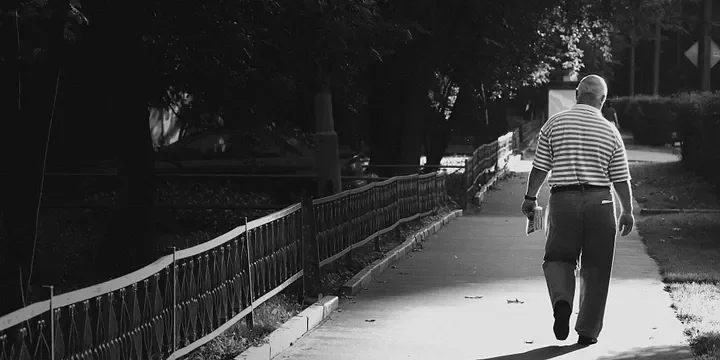
Kids who dislike going to school envy seeing older people strolling in the park, walking their dogs, or lounging at home watching TV.
But only in late life do people realize there’s no turning back. If one’s health permits, they can still do things they enjoy. If bedridden for a long time, even their loved ones might start to avoid them.
Regardless, elderly people in civilized societies, whether happy or not, at least have the comfort of old age.
However, the story told in the movie “Narayama Bushiko” plunges viewers into deep contemplation about human nature.
In a small village in the deep mountains of Shinshu, Japan, a tradition of abandoning the elderly persists due to extreme poverty: all those who reach 70 must be abandoned on Mount Narayama by their families.
71-year-old Mrs. Ling is nearing the day she must ascend Narayama. Despite her strong body, she’s distressed and intentionally knocks out two teeth on a millstone to appear older.
She does this out of fear that her eldest son, Chenping, won’t dare to carry her up Narayama, risking ridicule.
Facing fate’s arrangement, Mrs. Ling has learned to accept it calmly. Before departing for Narayama, she arranges for Chenping to marry Aiyu, teaches her to care for her husband, persuades Aijin to help their second son, Lijun, enjoy marital bliss.
Once everything is in place, Mrs. Ling sets off for Narayama. Chenping carries her up the mountain, and upon seeing piles of white bones on the mountain, he is reluctant to part with his mother. On the way back, he witnesses a neighbor pushing their 70-year-old father off a cliff.
Worried, Chenping runs back to check on his mother, but she says nothing, just waves for him to leave. As snowflakes fill the sky, Mrs. Ling calmly awaits death in the heavy snow on Mount Narayama.
Watching this movie, one deeply feels how difficult late life can be.
The movie’s premise is a local custom where due to extreme poverty, the elderly, seen as useless when old and frail, are considered a waste of food and are expected to be abandoned, even if their children are filial, they cannot break the rules.
To outsiders, Mrs. Ling is a “superfluous person” who has reached old age but not ascended Narayama, consuming more food. Yet, in the hearts of her family, she is revered, like a bodhisattva saving all beings, forever on the divine mountain, left for future generations to mourn and atone.
Ancient customs may be hard to grasp with modern thinking, but abandoning the elderly, both spiritually and physically, has always been a significant issue.
Thinking of this movie, I recall the news of an elderly woman buried alive by her son, which saddened me deeply.
The son, Ma, despised his mother’s inability to care for herself, throwing the 79-year-old woman into an abandoned grave and sealing it with soil. It was only after being buried for three days that she was rescued, even pleading for mercy for her son.
Parents always give more to their children and don’t expect much in return.
Like Mrs. Ling, she knows she can’t resist fate and accepts it calmly, not burdening her son.
As children grow older, parents always want to give them the best, even taking on all their problems.
Parents’ eyes always follow their children, even if hurt by them, but before leaving, they may still worry about them.
In late life, this heavy topic may be avoided for now, but one day it must be faced.
How should an elderly person’s life end ideally? Most think of being surrounded by descendants, a flourishing family, and a peaceful passing.
But not all elderly people can have their wishes fulfilled.
Throughout life, one keeps giving, sacrificing for family and children, meeting everyone’s needs but neglecting oneself.
When one can’t do anything in old age and is rejected by their children, becoming a burden at home and the core of conflicts, more and more elderly people see nursing homes as a solution.
Once raising children to care for them in old age, only to find that reality is harsh.
The most heart-wrenching part is not when there’s a disagreement with children but when children decide to abandon their parents in an instant.
Yet, in late life, though the path back is closed, one must prepare well for the road ahead.
In this new era, the custom of Narayama is a thing of the past. However, no matter the time, oneself is the biggest reliance, and this truth is undeniable.
One’s emotions and desires are hard to control, easily swayed by worldly matters.
Throughout life, burdened by worldly affairs, one might find they can’t influence many things in late life.
There’s no need to keep worrying about gains and losses; stepping back from it all can bring peace.
One spends a lifetime pursuing things, only to realize in the end that what one can truly grasp is limited.
So, at a certain age, one must learn to let go, shed burdens, to move forward with ease.
Regarding children, helping them when needed is good, but being miserly with one’s own strength is crucial. Yet, one shouldn’t completely take on all the responsibilities their children should bear; finding a balance is key.
In old age, it’s important to understand that children come because of oneself, not for oneself. They have their own lives and gracefully stepping back at the right time is a good thing for everyone.
Don’t complicate things for yourself, take care of your health, manage your emotions, prepare enough retirement funds, to lay a good foundation for late life.
As for the rest, thinking too much about it is futile; only by not letting down this final phase of life can one truly live a good life.